A Simple Production Function for Formidable People
Why weakness in any one input collapses the whole thing

Text 100% written by a human. Image made with ChatGPT, though I’m not delighted with it. It looks like a tellytubby had a go at it. Part three of four.
Thank you to the 500+ subscribers to what is really just me talking to myself to see what I think about things.
Part 1: Everyone has ideas. The difference is some people try to make them real. Why?
Part 2: How to Make More People Who Make Things:A typology
Part 3 (this one): A simple production function for formidable people
Part 4: (next week): This is the kind of institution we should create
The last two weeks argued the future is created by people who actually get on with the job of making things. These people are formidable. Formidable means someone who can go from idea to shipped reality under genuine uncertainty. They have justified confidence in their abilities.
We need more of them. I argue there are four kinds of institutions impacting the supply of formidable people.
Selection institutions-think the Young Scientist—identify latent formidability. (I’m never giving up the em dash folks).
Allocation institutions—think Schools and Colleges—distribute people across roles.
Transformation institutions—think the Scouts—increase formidability.
Amplification institutions—think YCombinator—increase returns to formidability
Ireland today has loads of allocation institutions, patchy selection institutions, thin transformation institutions and uneven amplification institutions.
OK, you’re up to speed. Off we go with the next bit.
I had a plan to outline an ambitious institutional idea but got stopped by an excellent commenter who asked what I thought the specific process for formidability formation was, which is something I hadn’t really thought through, and which really matters for the next part, so thank you very much for that.
My core argument is formidability is not personality. It is produced by repeated exposure to responsibility under uncertainty with feedback. Therefore institutions, which I think of as repeatable social technologies, can engineer it.
I have something like a production function in my mind, which is a semi-formal way of describing how inputs are transformed into outputs.
OK, enough basic economics. I’m going to suggest you increase formidability in this way. I don’t know how to typeset using substack so I’m going to block quote it.
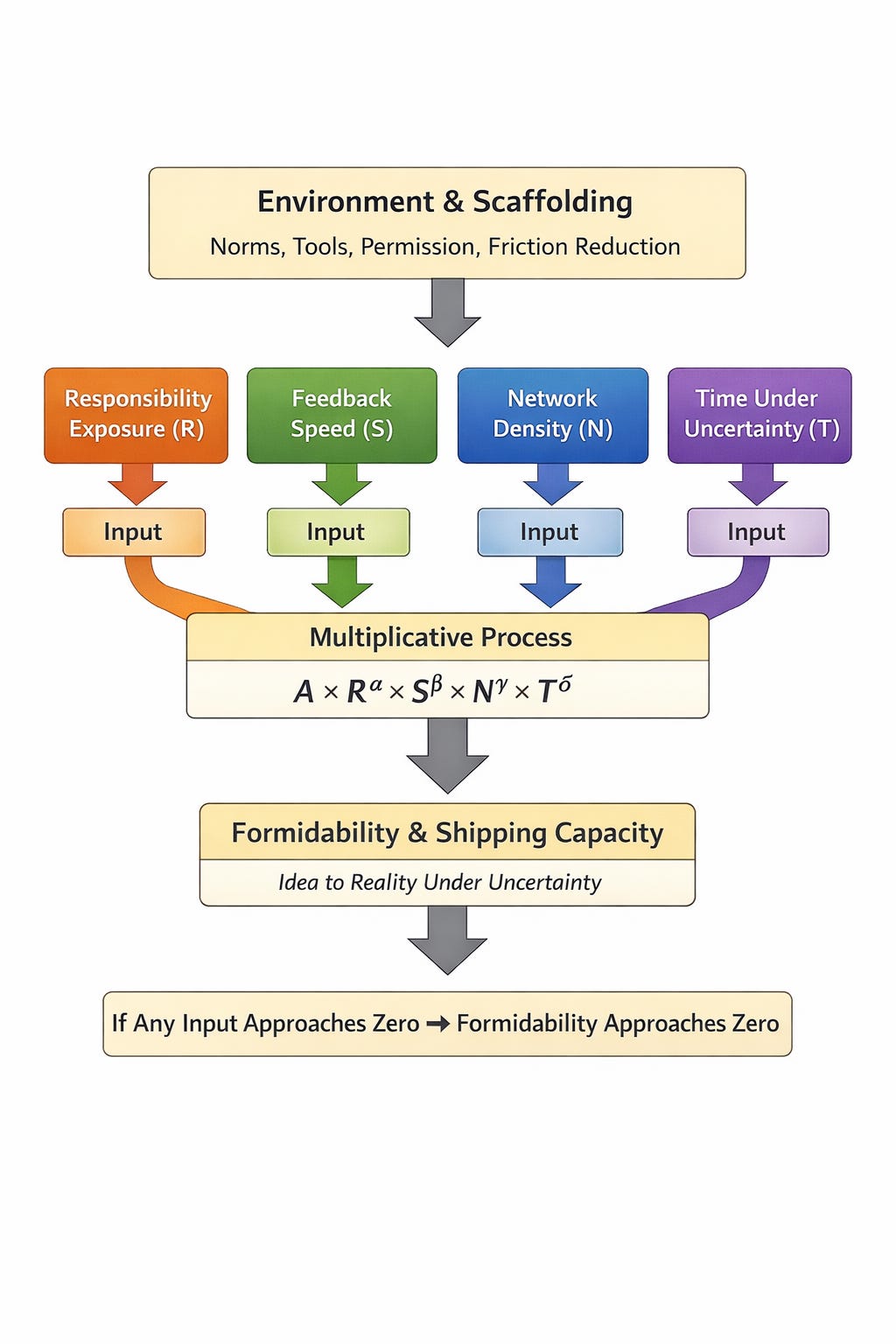
Formidability equals responsibility exposure x feedback speed x network density x time under uncertainty
In picture terms, at least to ChatGPT, it looks like this:
I’m not here for equations Steve. Explain yourself.
Item by item, by responsibility exposure I mean asymmetric responsibility. If you don’t do it, it visibly does not happen. I don’t mean your name is on something. Think about a typical group project at a university versus what happens in the Immersive programme where a student has to present working software to an actual company on a deadline. One has diffused accountability, the other has nowhere to hide. The felt difference is enormous and that felt difference is the input. The GAA club where a 17-year-old gets picked for the senior team and has to mark someone ten years older. Nobody asked if they were ready. That's responsibility exposure in a weekend. We don’t need to boil the ocean here. Responsibility exposure has to be real but not catastrophic. The sweet spot is "if this goes wrong, it matters, but you'll survive." Deep Springs sending 19-year-olds to manage cattle at 4am is a good example. The stakes are genuine (the cows need feeding regardless of your feelings) but the failure mode is recoverable.
By feedback speed I meant the feedback arrives quickly enough to change your next action. Feedback arriving too late to learn from, or implement, is as useless as a chocolate teapot. Think a coder pushing to production and seeing their error rate in real time versus a PhD student who submits a chapter and waits four months for comments. Same effort, wildly different learning velocity.A market trader knows within hours whether their thesis was right. An academic might wait years. Competitions like the Young Scientist compress feedback loops. In street performance, which Steve Martin references in Born Standing Up, you know within thirty seconds whether your material works. That brutal feedback speed is part of why comedy produces formidable people. A negative example: the Leaving Cert, where you work for two years and receive a single number at the end. This isn't an argument against exams, it's an observation about what they don't produce.
Network density is about the probability that any given conversation leads to a useful connection, collaboration, or challenge to your thinking. Not the number of people you know, but the combinatorial richness of your environment. David Byrne’s scene idea. CBGB wasn't special because of the building. The building was a kip. It was special because Talking Heads, Ramones, Television, and Blondie were all playing the same small room and watching each other. The reason certain university departments produce disproportionate output isn't the curriculum, it's that the people in the corridor are working on adjacent problems, talking to each other constantly, and openly competing with one another. For Ireland specifically I think network denisity is where scale becomes a constraint and an advantage simultaneously. The country is small enough that networks can be genuinely dense — everyone in Irish biotech is two introductions from everyone else and let’s be honest they are likely cousins. But that density is unevenly distributed geographically and, crucially, sectorally. If you're in Dublin or Galway in tech, network density is quite high. If you're in a rural area working on something unusual like say rocketry, it can be close to zero.
Time under uncertainty is the one that separates a weekend hackathon from something that actually transforms people. The input isn’t just exposure to uncertainty, it’s sustained exposure, long enough that you have to develop coping mechanisms, judgement, and the emotional tolerance to keep going when you genuinely don’t know if something will work.
This week I spoke with two founders taking leave from Immersive Software Engineering. We talked about the value of them burning their bridges entirely and just dropping out in order to really go for their start up idea. A weekend hackathon gives you a taste. A twelve-month startup with a do or die demo day gives you the real thing. The difference is that in twelve months you hit the point where the initial excitement has worn off and you still have to make decisions without knowing if they’re right. That’s where formidability actually forms.
Military training is designed around this deliberately, in that you’re not just enduring physical stress but prolonged decision-making under ambiguity. The uncertainty in some sense is the curriculum.
The farmer lives with genuine uncertainty as a baseline. Even with a heavy use of technology, from weather, to prices, to animal health, none of it is under their control, and they still have to act every single day. There’s a reason rural communities have historically produced really resilient people. As someone said to me years ago for a difficult role I was hiring for, “wide boy wanted, country boy preferred”.
Many professional training pathways think the academy, law, medicine, accounting, are designed to reduce uncertainty as quickly as possible through protocols, precedent, and procedure. Norms are everywhere designed to protect the professional. That’s appropriate for the profession (at least before AI) but it means the training itself doesn’t build tolerance for the kind of open-ended uncertainty that formidable people navigate. The person who leaves one of those pathways to start something new often finds they have deep skill but low uncertainty tolerance.
Weakness in any one term in practice collapses the output, so for example you can have someone who is given lots of responsibility, time under uncertainty, and feedback, but with low network density, they don’t really prosper.
Formidable people need somewhere, real or virtual, to go and to be together, and bounce off one another. Network density isn't a nice to have, and when it goes to zero the other inputs can't compensate past a certain point.
One key idea behind the production function that matters for you the reader right now is substitutability.
Some inputs can replace others, at least partially. That ‘elasticity’ is central, and I think often we don’t realise that much of the institutional design we do really impacts on the kinds of substitutability between elements.
Weakness in any one term collapses the output. You can substitute between inputs to some degree, in that sparse networks can compensate with better feedback speed, less time under uncertainty with increased responsibility exposure, but there are limits. When any input approaches zero, the others can't save you.
Notions: Where the Chain Breaks in Practice
Most people in Ireland go from school to college to employment without ever being given genuine asymmetric responsibility for anything that matters. You can be 28, highly educated, professionally qualified, and never once have had the experience of “if I don’t do this, it visibly does not happen.” That’s not a personal failing, it’s a structural one. Our allocation institutions are specifically designed to distribute people into roles where responsibility is managed, supervised, and shared. That’s of course rational for the institution—it reduces risk—but the production function idea I have discussed says near-zero responsibility exposure collapses the output regardless of how much you invest in the other inputs.
Ireland also has a feedback problem. The dominant feedback mechanism in Irish education is summative assessment. You do the work, you get a grade, the grade arrives after the learning is over. The Leaving Cert is the extreme case but the pattern repeats through higher education and into many workplaces. In the public and private sectors we have performance reviews once a year. Grant applications with six-month turnarounds. Planning permissions taking months/years/decades depending on their scale. The feedback exists but it arrives at a speed that makes real-time learning nearly impossible. Compare this to environments that reliably produce formidable people: startups where the market responds daily, sports where the scoreboard updates in real time, performing arts where the audience reacts immediately, art where the artist can see and feel their progress.
Network density is where Ireland’s scale cuts both ways as I’ve said. In Dublin’s tech scene, which I know pretty well, density is genuinely high. The Irish policy scene which I know very well is less than five square kilometres across, with the Department of the Taoiseach at the centre of that square.
Density is extremely uneven by sector, region, and class. If you’re a young person in a rural area fascinated by materials science or game design or fine art, the number of people within reach working on adjacent problems may be literally zero. That’s a collapsed multiplier. And even in dense environments, networks are often sectorally and sub-sectorally siloed. Academia talks to academia, policy to policy, business to business. It gets worse the finer the sub category gets. If you’re in Limerick doing behavioural economics you might well be entirely on your own. The cross-pollination that characterised Bell Labs or Building 20 at MIT is rare here.
Irish culture has a relatively low tolerance for sustained uncertainty as a life choice. (And yes, I know I say this as a tenured Professor). There are strong incentives to resolve uncertainty as quickly as possible. Get the qualification, get the permanent job, get the mortgage, don’t have notions. Each step is individually rational but cumulatively they keep the time-under-uncertainty input artificially low. Even our entrepreneurship supports tend to be pretty short-burst, a weekend here, a six-week or -month accelerator there. These give people a taste of uncertainty but not enough sustained exposure to develop the judgement and emotional regulation that formidability requires.
Failures compound
The deepest issue is that these failures compound. If you never get real responsibility, you never generate the situations that would produce fast feedback. If your network is thin, you don’t encounter the people who would challenge your thinking or offer you responsibility. If your culture incentivises resolving uncertainty quickly, you never stay in the uncomfortable zone long enough for the other inputs to take effect. Environments that provide one input tend to provide the others. Environments that starve one tend to starve all of them. This is why the occasional intervention, a weekend programme here, a mentorship scheme there, rarely produces lasting formidability. It boosts one input temporarily while the others remain near zero. It is diet-formidability.
Which is the argument for Part 4. Each institution that targets one input in isolation is fighting the multiplicative structure of the production function. The only answer is what I'll call an integrated formation institution, something designed from scratch to tune all four inputs simultaneously.
That’s next week.
Excellent article; two questions:
1. How do you ensure that you’re not throwing people off the deep end of uncertainty? I’m assuming there is some threshold after which you’re exacting too much stress onto the individual for them to take any proper learnings away from it. And further, how do you ‘scale’ this uncertainty as a person’s formidability grows? What gauges and levers can institutions use to keep it appropriately calibrated?
2. Is network density a *first-order* impact on formidability formation? It seems to me like it moreso affects your success. As an extreme example, someone stranded on an island would likely quickly become formidable, without having any network whatsoever.
And I'd be really curious to see if this system holds up when applied to the military training programs.
"Transformation institutions—think the Scouts—increase formidability"
This got me thinking, Steven, so thank you.
The other day, someone was commending me on the fact that I "get s**t done". I'll use two recent examples.
First, whilst others moot the idea of using AI, I started developing my own one based on my corpus of work about a year ago, and it launched last September.
Second, I latched onto the fact that independent businesses in the UK tend not to donate to charity. There is a method called "Gift Aid" where individual donations can have basic rate tax claimed back by the charity to augment the amount donated, so people do that. What I worked out was that, for successful independent businesses (where marginal tax can be over 60%), giving through your business is far, far more tax efficient. So what did I do? First, I chose my charity, then I made a chunky donation, then I added an option (via the Collinson's Stripe ;) ), so people booking ad hoc calls with me are encouraged to donate to. Next, I'm hosting a business dinner at the nearest Maggie's Centre to me, and then we will see where we go.
I have an idea, I do stuff, and then I do more stuff.
What transformative "institutions" helped me be more "formidable" (using your terms)? A few come to mind:
- My father and his passion for racing cars. Things often went wrong; solutions had to be found. I was there in the paddock as he did that, then (latterly) helping him fix things
- The Scouts (yes), then the British Army (starting with the CCF when I was at school from about age 13)
- All of those (in hindsight) provided a foundation for me as a competitive athlete, something I did at a high level from my late teens for many years.
Over my career, I have hired hundreds of people across many sectors. One heuristic I always looked for was whether people had competitive sports or other non-academic experience that had been formative for them, so when we scored candidates to short list them, such non-academic elements (including, yes, that if someone came from a less privileged background and had still go the academic grades), these indicated to me that they would be more successful in a business culture that wanted people to get s***t done and, at the same time, challenge norms and challenge their bosses.
Did I do the sort of rigorous analysis you are doing (some of it looks like trying to put number to post-rationalise, but hey, academics "you be you" !)? No, I didn't. Tbh, your piece was a little to tl;dr for me. Whilst I am a voracious reader and learner, sometimes I just latch onto an idea and "gsd"!
Thanks for the idea and sparking thoughts!